
What Is a Murabbi? The Forgotten Meaning
The word Murabbi (مربي) comes from the Arabic root ر ب ب R-B-B), connected to Rabb – our Creator, Sustainer and Nurturer. A Murabbi is someone who nurtures, develops and guides another person towards growth. This is the essence of tarbiyah: gradual, intentional nurturing. It is much deeper than getting someone to obey.
A teacher may give you knowledge.
A mentor may share experience.
A coach may help you develop a skill.
But a Murabbi nurtures the whole person – their character, their thinking, their potential, their relationship with Allah, and their understanding of who they are.
A Murabbi doesn’t simply ask:
“What should this person do?”
They ask:
“Who is this person becoming?”
And ultimately:
“Are they becoming more connected to their Rabb and the purpose for
which they were created?”
That is the forgotten depth of Murabbi.
Where Did the Murabbis Go?
Perhaps the most uncomfortable question is not what is a Murabbi? It is: Where did they go? We live in a world overflowing with information, yet increasingly starved of deep human connection. Children spend hours absorbing content from screens and algorithms while the adults around them struggle with exhaustion, distraction and their own emotional regulation. We have become very good at managing behaviour.
We tell children what to do.
We correct them.
We monitor them.
We worry about their grades, their screens, their manners and their future. But who is sitting beside them long enough to understand how they think? Who is helping them understand their emotions, their fitrah, their potential and their purpose? Who is reminding them that this life is a test and that their relationship with Allah is at the centre of it all? We can find someone to help a child perform better. We can find someone to help them develop a skill. We can find someone to help them achieve a goal. But a Murabbi does something deeper. A Murabbi helps a person reconnect with their Rabb. And without that anchor, even growth can become another form of achievement.
Perhaps this is why the extinction of Murabbis matters so much. We are not simply losing mentors. We risk losing the people who were meant to nurture the leaders of tomorrow from the inside out.
The Greatest Murabbis Were the Prophets
The greatest examples of this kind of nurturing were the Prophets. They didn’t simply deliver information. They understood people.
The Prophet SAW – Correct Without Humiliating
When a Bedouin urinated inside the mosque, the companions wanted to stop him immediately. The Prophet SAW told them to leave him until he had finished, then had water poured over the area. He reminded them that they had been sent to make things easy, not difficult. (Sahih al-Bukhari 220) He corrected the behaviour without humiliating the person.That is the heart of a Murabbi: protecting the person’s dignity while guiding their behaviour.
Prophet Ibrahim AS – Cultivate Conviction
When Ibrahim AS was commanded to sacrifice his son, he said:
“O my dear son! I have seen in a dream that I must sacrifice you. So tell me what you think.”
His son responded with his own willingness to submit to Allah. (Qur’an 37:102)
Ibrahim AS wasn’t simply raising a child who followed instructions. He was nurturing conviction.
Prophet Ya’qub AS – Keep the Long View
When Prophet Ya’qub AS’s sons lied about Prophet Yusuf AS, he responded:
“No! Your souls must have tempted you to do something ˹evil˺. So ˹I can only endure with˺ beautiful patience! (Sabrun jameel) It is Allah’s help that I seek to bear your claims.” (Qur’an 12:18)
Years later, those same sons acknowledged their wrongdoing and asked for
forgiveness. (Qur’an 12:91–98)
Ya’qub AS’s story reminds us that tarbiyah is not about winning today’s battle. It is about keeping sight of who a person can become.
The Prophets didn’t simply teach people what Allah wanted them to know. They nurtured people until what they believed began to shape who they were.
The Murabbis Who Shaped My Life
When I think about the Murabbis who shaped me, I don’t first remember their qualifications, I remember how they made me feel.
My Qur’an Teacher Who Taught Me What Contentment Looked Like
One of the first people who comes to mind is Auntie Shameem. At the time, I was 13 years old. She would walk to our house to teach me the Qur’an’s translation. Her life was full of worries. The government was threatening to take her house away. She was deeply concerned about her son and the things he was watching. One of her daughters was going through paranormal difficulties that frightened her deeply.
She had plenty of reasons to arrive exhausted, worried or defeated. And yet, she would walk through our door with a bright smile. I remember asking her how she was. What stayed with me wasn’t simply her answer. It was her face. There was a calmness in her eyes. A softness. A contentment that seemed almost out of place considering what she was going through. She would say ‘alhamdullilah’ and I knew she meant it! And when she smiled, it felt as though light shone through her teeth. I had a comfortable life. I was extremely blessed. And yet, I didn’t have that calm.
She came to teach me the Qur’an. But her state taught me something much greater: What life can look like when a person is anchored to Allah. I don’t remember every lesson she taught me. I remember who she was when she taught me. And that is the quiet power of a Murabbi.
Sometimes, your state becomes the most inspiring lesson. To this date I chase that level of contentment!
Dr. Abid Ali: The Murabbi Who Believed in Me
When I began teaching and designing the curriculum for Islamic studies, I desperately wanted a mentor. I wanted someone who had walked the path before me and could tell me what to do to help children understand and love their deen. I couldn’t find that person. So I turned to the life and teachings of the Prophet SAW and began copying him as a teacher. Then, unexpectedly, Dr. Abid Ali came into my life. The very person whose lecture had inspired me to think about education differently!
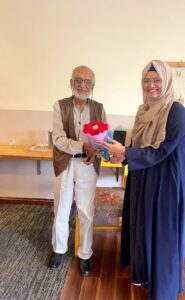
What surprised me was that he didn’t tell me what to do. He didn’t check my work or give me a list of instructions. Instead, he guided me towards the questions I needed to ask, the faith I needed to develop, and the person I needed to become. But what affected me most was the way he spoke to me.
He would say my name and speak to me with such genuine respect that I sometimes found it almost confusing! I was not used to this level of respect! Here was someone much older and far more accomplished than me, yet he spoke to me as though I were the most important person!
He believed in me more than I believed in myself.
He didn’t guide me through every step.
He helped me discover that I could walk on my own.
He also changed the way I saw children.
He found children fascinating.
Where others might see difficult behaviour or endless questions, he saw endless
possibility. He taught me to ask:
What is this child thinking?
What made them ask that question?
Instead of rushing to correct children’s conclusions, he taught me to become curious about the thinking behind them. He saw children not as problems to manage, but as human beings whose minds, character and potential were still unfolding. That changed the way I taught. And it changed the way I saw children.
I met him at the last stage of his life, doctors had given up on his health conditions years ago and yet, gratitude, calmness and contentment flowed through him! May Allah grant Dr. Abid Ali, the highest rank in Jannah, and allow the good he planted in others to continue as sadaqah jariyah for him. Because that is what a Murabbi leaves behind:
people who become more of who Allah created them to be.
He is my inspiration to become a murabbi, so that one day, just my mere presence becomes a
source of return for everyone around me!
Stop the Extinction. Become a Murabbi
When I look back at the people who shaped me, I realise something: I cannot simply wish for more Murabbis to exist. I have to become one. Especially for my own children. Not because I have mastered parenting. Not because I have all the answers. But because if I want to nurture children who know themselves, know their Rabb, and understand their purpose, I have to keep working on myself too. That requires khudi – a healthy balance between humility and confidence.
Humility:
I am who I am because of Allah’s blessings.
Confidence:
Allah has placed endless potential within me.
Without humility, we can become controlling. Without confidence, we can become passive. A Murabbi needs both. Because being a Murabbi isn’t about having all the answers. It’s about becoming the kind of person whose presence makes you pause. Pause long enough to ask:
Who am I? What am I becoming? What should I hold on to – and what do I need to let go of?
A true Murabbi doesn’t simply tell you what to do. Their presence can make you see yourself more honestly. They help you recognise your strengths without becoming arrogant, your weaknesses without becoming hopeless, and differentiate between the choices that bring you closer to Allah – and those that take you further away. And sometimes, in the presence of a Murabbi, you are reminded to step back from the noise of this world and see it for what it is: temporary. Because ultimately, a Murabbi is not trying to make you dependent on them. They are enabling you to find your way back to your Rabb while giving you the confidence that you can do it on your own.
Before Allah changes the people around us, He often begins by changing us. Every Murabbi Begins as a Student.
Want to Become a Murabbi?
If this idea made you pause and wonder about the kind of influence you are having on the people around you, this is where my work begins.
Through Tazeen Rethinks, I help parents and educators understand themselves more deeply, recognise the patterns that get in the way of connection, and develop a more grounded approach to nurturing others.
Want to understand your own shortcomings and find your peace and balance?
Book a free consultation session.